Living in the Liminal: A sojourn of shedding, shifting, and surrender
I’d been living in a New York minute for 21 years, chasing subways, promotions, late-night parties and some invisible finish line that never arrived. I was depleted, and the usual levers I pulled to power through weren’t working anymore. I thought a week alone in a cozy yurt, wrapped in the northern New England woods with nothing to do beyond keeping the fire blazing, might be the reset I needed.
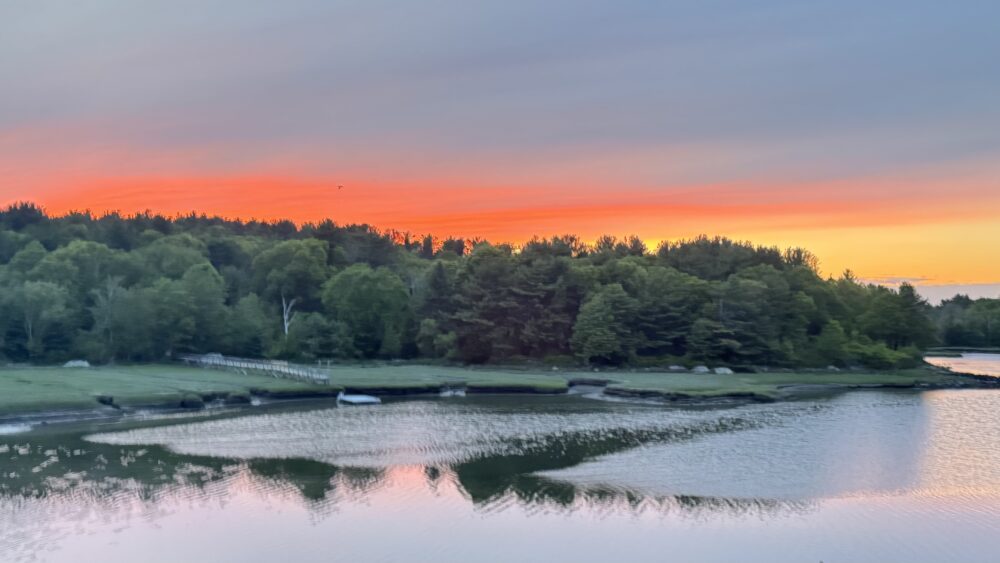
The yurt felt indulgent in the simplest ways. Its circular shape was cocooning yet spacious with a wood stove and sitting nook, a fully stocked kitchen and a queen sized bed stacked high with brightly colored blankets and overstuffed pillows. Monsoon like rainfall pounded on the canvas tent for days, adding to the coziness. For the first time, having nowhere to be without anyone to meet wasn’t loneliness- it was freedom. I laid on the floor for hours on top of a cushy hide blanket, staring up at the skylight looking through the crown of the yurt watching the clouds pass, still listening to the heavy patter of rain on the canvas. I fed logs to the stove, feeling proud that I could build fires and brave the outdoor toilet in the cold, wet fall air.
 In that moment, I had everything I needed, which wasn’t much, a sharp contrast to the life I’d curated in the city. I found myself daydreaming of a farmhouse with a vegetable garden, maybe even a yurt of my own. And suddenly a thought I’d long ago filed under the idea of failure surfaced: Was there a life waiting for me outside of the identity I’d built in New York City? I asked this out loud to no one, and let it be true.
Eight months after that week in the yurt, I left New York City. Six months later, I left my career. A month after that, I booked a one-way flight to Ecuador. I told people I was going on an adventure, but really, I was determined not to come back. Starting a new life in a foreign country seemed like the best narrative to mask the internal collapse I found myself in. Instead, I’d fly away and call it freedom.
I landed in Montañita, a surf town on Ecuador’s Pacific coast, known for great waves and a good time. The place was in constant celebration, turning the dial all the way up most days of the week. Ask anyone who’s been and they’ll agree, Montañita’s energy will take hold of you in a tight grip and suddenly those who arrived for a week end up staying a season, then return for the next. Some never leave. If you stay long enough, the sun softens and the clouds roll in, and the same stories come into view from another lens, wondering about the ones who stayed and what they’re outrunning and catching whispers from the locals realizing some stories are better left untold.
Despite the constant churn of travelers, the locals and expats were a friendly, close-knit group, and I quickly found a community, becoming another statistic, arriving for ten days and staying three months. I’d built a solid crew who carried me through the beginning of my “sabbatical”, a notion I resisted, convinced I hadn’t earned it. We shared meals, took trips to nearby towns, spent long days on the beach and made a weekly pilgrimage to Lost Beach, the town’s oceanfront nightclub, a sprawling party palace bumping dance music seven nights a week. After hours spent dancing under palm trees, we’d walk home along the sand at sunrise, the beat trailing us down the shore, giggling about the night’s antics.
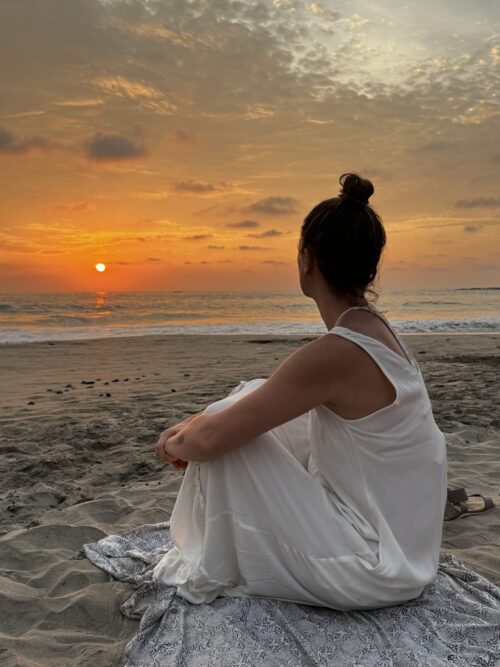
Everything I thought I wanted was there; an extended tropical stay, sun-drenched days and a bungalow on the sand, an open calendar with nowhere to be and no looming return to the grind. There were sunsets that stopped conversation, and new friends to watch them with. This was freedom, baby! But instead of feeling free, I felt removed, like a viewer behind glass. Physically, I was in paradise, but my mind wouldn’t loosen its grip on answers I didn’t have, and didn’t know how to find. So I kept busy the only way I knew how, by overindulging in everything.
After a massage with a local healer, as I was slowly coming out of a transcendental state, she came and stood beside me. “I have a message for you,” she said. She leaned in and whispered one word so close to my ear my whole body shivered: “Surrender.” Tears began to flow as the word pressed down, huge and undeniable, like an elephant on my chest.
I had no idea how to begin to let go after carefully cultivating a life of control, my protection, my armor. As a kid, I was told I was too much: too tender, too combative, too many emotions. So I built armor that read as a difficult child, and I carried that label until it became true. By the time I was grown, it wasn’t something I wore, it was part of me. But the armor had become too heavy to fight in, and too tight to live inside.
By the time I reached the retreat center in the Bolivian Amazon, I’d been traveling for seven months. My mind was crowded with questions I couldn’t name, and my body was spent from searching everywhere but inward. After months of moving through Mexico, enduring a bout of dengue fever and welcoming my 4th decade of life, the jungle was a reprieve. It was indifferent to my urgency and very clear about its terms. It isn’t a place to outwit or rush, and presence is non-negotiable. Step carefully, pay attention, move with respect. The same plants that heal can harm, and the same paths that open can close. I learned to let the day be small, to listen more than speak, to defer to the living order and to hold reverence for the Indigenous people who shared their land and knowledge so that our healing could happen.
I met Patricio the night before, in our hotel, both of us buzzing with a bright mix of nerves and excitement, anticipating the next ten days of a plant medicine retreat. We sat on the balcony smoking our last cigarettes for a week, trading stories and learning we had once lived down the street from one another in Brooklyn. Argentine, his energy and voice filled a room, always talking with his hands, opinions landing fast with an eccentric but disciplined charge to him. He had a face that held both joy and sorrow, laughing big, often with tears not far behind. A year earlier his world had stopped with a phone call about the tragic death of his mother, and again, we’d find ourselves in the same place, this time in the depths of the Amazon, both in search of the freedom to move us beyond our grief.
Swinging in the hammock on our second day in the jungle, he offered Reiki to help my headache which I’d had for weeks. He placed his hands above me, and within seconds, whatever I had been holding released all at once. Patricio removed his hands from above my head and immediately began to weep, while I burst into a wild and guttural laughter so unexpected, it startled the birds from the trees. After the moment passed and we were quiet again, I felt emptied and strangely lighter. In that moment, I allowed the wisdom of the jungle to begin to soften me and a deep relief followed. I was being held.
We entered an eight-day dieta of oats and suggested silence, no salt, no sugar and no distractions, in preparation for four ayahuasca ceremonies. With no idea what to expect, I entered the first ceremony with one intention, to surrender to the medicine, however she chose to show up. She didn’t reveal herself as visions or the voice of God declaring a tidy set of answers to life’s questions; the medicine went for my body first.
Pain moved in relentless waves, untangling knots I didn’t know I held, loosening the child-built armor once needed for protection, now holding me back from real intimacy, creativity, and my internal power I had not yet learned how to harness. As the medicine worked through me, I surrendered to the pain and let my body do the work, laboring through surges of agony contorting my limbs in directions that felt both punishing and merciful, contractions unleashing one after the other, like I was birthing a child.
I left the jungle quieter inside and more trusting of myself, giving me a fresh sense of purpose for the remainder of my travels. What I wanted was simple: to be outside, to connect with land, to work with my hands and learn a new skill. I left with the promise of fewer “shoulds” and a newfound energy.
My travels continued as I migrated to a homestead in Turkey built by women who had turned a mountain of soil into a home with their bare hands. I let their strength and the groundedness of the land seep into me, until I had the courage to admit I couldn’t go on like this. I cancelled my travel and called my father and stepmother. “Can I come and stay with you for a little while?”
The emotional whiplash of returning to the place I’d only ever dreamed of leaving was unmooring. Some mornings I jumped out of bed, sure clarity was around the corner. Others I’d drop into hopelessness with sobs loud and raw, collapsing on the kitchen floor while my dad stood nearby. He gave me space to sit with my pain without pulling me out of it, his presence itself a lesson: real love doesn’t fix, it witnesses.
I found myself wondering how I’d gone so far only to end up exactly where I started. Gratitude tangled with frustration and relief blurred with regret. I was no longer a New Yorker, no longer a woman who could measure her worth through output and titles, no longer a traveler, no attachment to anyone or anywhere. If I wasn’t any of those things, then who was I?
I spent hours every day in the woods and along the ocean, letting the land set the pace. Slowly, my nervous system began to soften; I could drop out of my head and back into my body, feel the ground under my feet, and remember I was safe. In the way the waves kept returning to shore and the pines kept standing guard, I found a rhythm and experienced that full body “yes”, letting me know I was exactly where I was supposed to be.
And that’s when he came into view, not new but newly visible after circling each other for a decade. When he re-entered my orbit, it felt like a click, as if our lives had been aligning to the same frequency and the universe had finally dropped us in front of each other, ready for the next chapter. He fit perfectly into the story, and now, right on cue, the partner I’d been calling in had arrived.
I fell for the story harder than I fell for him. He set the rhythm and rules of our long-distance relationship, and I told myself the longing for more laughter and connection would naturally evolve, so I bent myself around his limits and called it compromise. Friends cheered us on, synchronicities stacked up, and I let those external nods of affirmation drown out the persistent no in my body. Underneath the story I was diligently creating, my nervous system was running an old script. I was still organizing myself around being “too much,” still chasing regulation in someone who wasn’t regulated themself, so cut off from their own heart they couldn’t possibly meet mine.
I was weeks away from packing up my life in the place I’d fallen in love, my safe space, my home to move away to his. My chest tightened every time I tried to picture us living together. I began waking up night after night, ripped out of sleep by panic, my heart hammering, my body flushed with heat. My gut twisted with every conversation I held back with fear of disappointing him, and still I kept rearranging the facts to protect the fantasy.
The call lasted three minutes. His voice was cold and robotic, as if we were closing out a contract instead of a future. There was no conversation, just a clean slice. “I’m out.” And just like that, he was gone. A relief settled over me before my ego sprinted in with its oldest script. See, it said, everybody leaves. You trusted someone instead of your own body, and they took it all away.
My father sat beside me as I rocked back and forth in loud sobs, while another truth slipped in. I was surrounded by people who loved me. I was, in fact, the farthest from alone I had ever been.
This wasn’t the universe punishing me; it was pulling me out of something my body already knew wasn’t safe. My time in the great in-between had been training me for this. Surrender isn’t a pretty mantra. It’s trusting that when something is stripped away, it’s for my protection and that the point was never a story tied up in a perfect bow, but a life built on trusting my own knowing.
This is the short version of a longer project I’m writing from inside the liminal, messy middle of starting over.
CannaMend Salve

You May Also Like
I Have Boundaries, Dammit! How a Misspelled Tattoo Became the Symbol of My Return to Self
Finding My Artist, Unlearning a Family Fact